Prices have not refreshed for a while. You are seeing the last rates we received.
USDT P2P buy/sell spread: why selling pays less than buying
On P2P markets in India right now, buying 1 USDT costs about 104.16 rupees, but selling 1 USDT gets you about 101.28. That gap, 2.77% of the buy price, is the buy/sell spread. It is roughly what you lose if you buy USDT and sell it straight back. Below: why selling almost always pays less, what to make of buyers who offer more than the market, and how to pick one when you sell.
USDT to INR buy and sell rates today Previous guide: why USDT costs more than the dollar rate →
What the spread is
Every P2P market has two lists. Sellers post the price at which they will sell you USDT; buyers post the price at which they will take your USDT. The best price on the first list is almost always higher than the best price on the second. OTCju measures the gap like this:
Spread = (buy price − sell price) ÷ buy price
With India’s numbers right now: (104.16 − 101.28) ÷ 104.16 = 2.77%. Put another way, if you bought 1,000 USDT for about 104,163 rupees and sold them back at once, you would get about 101,275: roughly 2,887 rupees less. Over the last 30 days, the spread averaged 1.28%, so today’s gap is wider than usual.
Both prices are medians of the top ads across several platforms, not the single best ad, so they are close to what you can actually trade at. The spread is a different thing from the P2P premium: the premium compares the buy price with the dollar exchange rate, while the spread compares the buy price with the sell price.
Why selling pays less
Most of the time, whoever buys your USDT on P2P is a merchant: someone who trades all day, buying from sellers and selling to buyers. The spread is how they get paid. What goes into it:
- Their margin. A merchant who buys at one price and sells at a higher one keeps the difference. With many merchants competing, that margin gets thin; with few, it stays wide.
- Money tied up. A merchant has to keep both rupees and USDT on hand to serve both sides. Money sitting idle has a cost, and the price reflects it.
- Bank risk. A busy P2P merchant receives a lot of payments from strangers. In India, one complaint about one payment can get a bank account frozen, and merchants price that risk in. Crypto trades are also taxed in India, which adds to their costs.
- Prices that move. When the local currency is jumping around, a merchant who buys your USDT now does not know what they will get for it in an hour, so they leave more room.
Nigeria shows the other side. Naira P2P is a busy market with many merchants quoting both ways, and the spread there is 0.08% right now (0.12% on average over 30 days), narrower than India’s. Of the 46 currencies with a live sell price on this site, the widest gap right now is in Brazil, at 7.62%.
The spread is not a platform fee. Taking an existing ad on Binance, OKX or Bybit P2P is usually free; the gap is in the prices the traders themselves set.
Reading the sell list
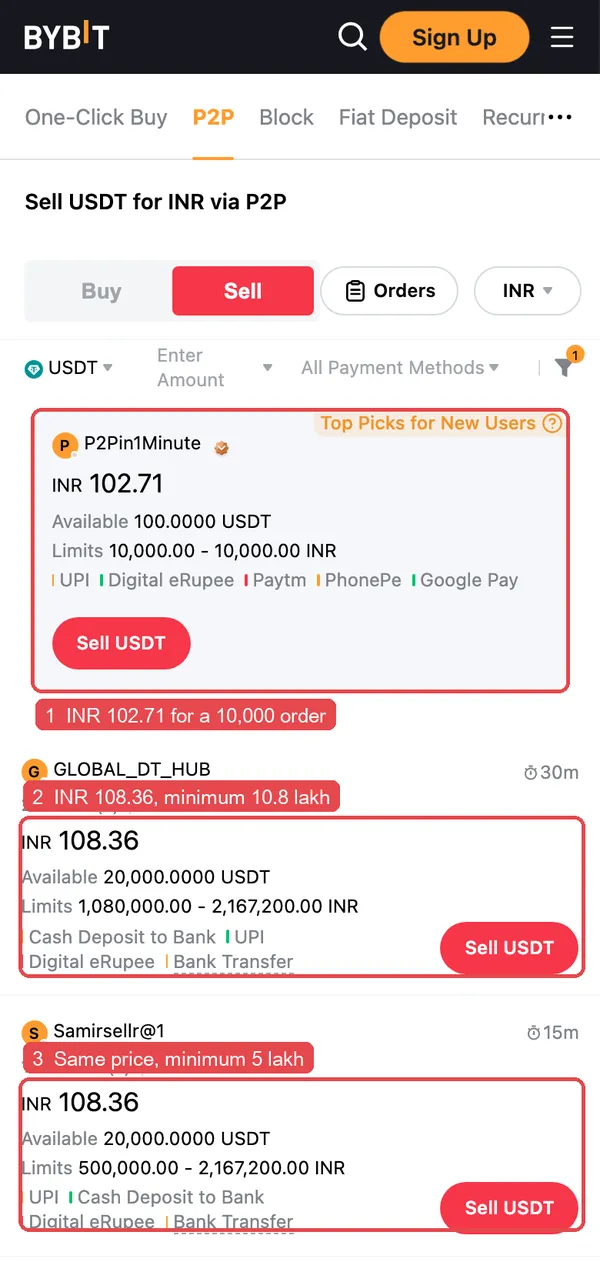
When you tap Sell, each row is a buyer: the price they pay per USDT, how much USDT they still want (Available), the smallest and largest order they accept, and how they pay. This is Bybit’s rupee list on 14 November 2026:
What to take from it:
- A price only counts if your amount fits the limits. Ad 1 pays 102.71, but its minimum and maximum are both 10,000 rupees, so it takes one order of about 97 USDT and nothing else. Ads 2 and 3 pay 108.36, about 5.5% more, but the smallest order they take is 10.8 lakh and 5 lakh rupees. If you are selling 200 USDT, worth around 20,000 rupees, none of the three fits.
- A featured box is not the best price. The platform picks what goes in “Top Picks for New Users”. Here it pays less than the two ads under it, and the best price for your amount may be further down.
- Check how the buyer pays. Ad 1 pays by UPI, Digital eRupee, Paytm, PhonePe or Google Pay. Ads 2 and 3 list UPI and Digital eRupee too, plus Cash Deposit to Bank and Bank Transfer. If a buyer pays in a way you cannot or would rather not receive, the price does not matter.
- Look at the trader’s record. Binance shows each buyer’s number of orders and completion rate on the row itself (see the next screenshot). A buyer with few orders or a low completion rate is more likely to leave you waiting or open a dispute.
The quickest fix is to type your amount in the Enter Amount box first. The list then shows only buyers whose limits fit.
Buyers who pay more than the market
The 108.36 in the screenshot above is not just higher than the other buyers. At that moment, sellers on Bybit were asking a median of about 97.25 rupees for 1 USDT, so those two buyers were offering about 11% more than it cost to buy USDT on the same platform. Our India buy price was about 104.7 and our sell price about 100.4.
If ordinary sellers could fill those orders, traders would buy at 97 and sell back at 108 within minutes, and the gap would close. It stays open, which tells you an ordinary seller rarely gets that price. The usual reasons are a minimum far above what most people sell, a payment method many sellers cannot use, or extra terms in the ad that you only see once you open it.
Kuwait shows the same thing more clearly. This is Binance P2P on the same day, selling USDT for dinars:
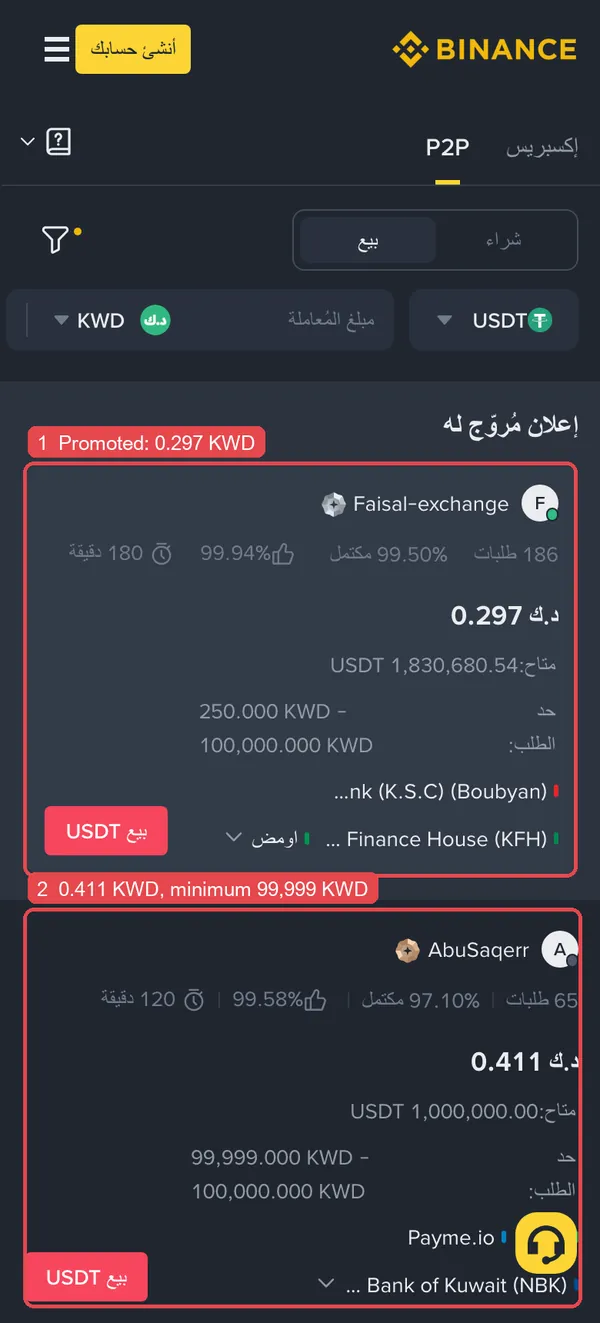
The reference rate was about 0.3113 dinar per dollar, and our Kuwait buy price was about 0.3178. The ad marked 2 pays 0.411, about 32% above the dollar rate. But the order has to be between 99,999 and 100,000 dinars, roughly $320,000, which rules out almost everyone. Further down the list, out of the frame, two more ads had the same price and the same minimum. And the promoted ad at the top, the one many people tap first, pays the least: 0.297, about 4.6% below the dollar rate.
Off the platform the risk is different. A message on Telegram, WhatsApp or a direct chat offering well above the market rate is a common warning sign: the money may come from fraud. If a victim reports the payment, the account that received it can be frozen, and that account is yours. Outside a platform order there is no escrow and no appeal. Ways to lower that risk are in how to sell USDT on Binance P2P.
OTCju keeps these ads out of its sell price. If a platform’s buyers are paying more than 3% above the higher of that platform’s own buy price and our headline buy price, that platform’s sell quotes are dropped from the sell price entirely (how we calculate prices). We added the rule after a case in roubles: in November 2026, HTX had about 340 identical buy ads, all priced more than 11% above what sellers on HTX were asking.
Platforms whose sell price we leave out right now
| Platform | Currency | Buyers’ median price | Our buy price | Above our buy price |
|---|---|---|---|---|
| Binance P2P | Kuwait (KWD) | 0.3725 (20 ads) | 0.3190 | +16.77% |
| HTX P2P | Russia (RUB) | 99.09 (10 ads) | 85.15 | +16.38% |
| Bitget P2P | India (INR) | 118.71 (20 ads) | 104.16 | +13.96% |
| Bitget P2P | UAE (AED) | 4.030 (21 ads) | 3.742 | +7.68% |
| Bybit P2P | India (INR) | 108.37 (20 ads) | 104.16 | +4.04% |
Buyers’ median price is the middle of that platform’s top buy ads (the ads you sell into). These platforms still count toward the buy price; only their sell quotes are dropped. The list changes with every update. In India it is Bitget P2P and Bybit P2P right now, the same kind of ads as in the Bybit screenshot above.
Spread by country, live
The spread varies a lot from one market to the next. These are live prices for 1 USDT in local currency:
| Currency | Buy 1 USDT | Sell 1 USDT | Spread now | 30-day average |
|---|---|---|---|---|
 Nepal (NPR) |
176.50 | 163.13 | 7.58% | 8.02% |
 Turkey (TRY) |
53.86 | 51.07 | 5.20% | 2.78% |
 South Africa (ZAR) |
17.68 | 17.00 | 3.82% | 5.37% |
 India (INR) |
104.16 | 101.28 | 2.77% | 1.28% |
 Kuwait (KWD) |
0.3190 | 0.3105 | 2.66% | 1.69% |
 UAE (AED) |
3.742 | 3.676 | 1.79% | 1.16% |
 Pakistan (PKR) |
289.88 | 288.24 | 0.56% | 0.64% |
 Indonesia (IDR) |
18,373 | 18,276 | 0.53% | 0.47% |
 Philippines (PHP) |
64.28 | 63.94 | 0.52% | 0.52% |
 Kenya (KES) |
130.69 | 130.18 | 0.39% | 0.46% |
 Russia (RUB) |
85.15 | 84.85 | 0.35% | −0.69% (8 days) |
 Ghana (GHS) |
12.23 | 12.22 | 0.08% | 0.14% |
 Nigeria (NGN) |
1,414.00 | 1,412.94 | 0.08% | 0.12% |
 Bangladesh (BDT) |
129.66 | 129.86 | −0.15% | −0.33% |
Spread = (buy price − sell price) ÷ buy price, using the median of the top P2P ads across platforms. The 30-day average applies the same formula to each day’s average buy and sell prices and only counts days with a usable sell price. A negative spread means buyers’ prices are above sellers’ prices for now; the two sides are different traders, so it is not a profit you can lock in. Days whose average sell price was more than 3% above the buy price count as having no sell price: Russia 22 days in the last 30. How this is calculated →
How to pick a buyer
- Start from your amount. Type it in before you look at prices. The top price on the list is often out of reach because of its minimum; the price that matters is the best one that takes your order. Currency pages such as USDT to INR today show what buyers pay for several order sizes.
- Do not chase the highest number. A buyer paying far above everyone else is usually out of your range or has conditions. A slightly lower price from an ordinary buyer is often the better deal.
- Check orders and completion rate. Prefer buyers with hundreds of completed orders and a completion rate in the high 90s.
- Release only when the money shows in your own bank or wallet app. A screenshot, an SMS or the buyer marking the order as paid is not enough.
- The payment must come from the buyer’s own account, in their own name. If the name does not match, do not release; open an appeal. Use an account in your own name too, whether that is a bank account, UPI or a wallet such as OPay.
- Keep the trade inside the order. Ignore private offers above the market rate. Without an order there is no escrow and no appeal.
Prices, spreads and the table of left-out platforms are live and update every few minutes. Screenshots taken on 14 November 2026 in a phone browser, not logged in; the figures in their captions are from that moment. Text checked: 2026-11-14.
Common questions
What is the USDT buy/sell spread?
It is the gap between what you pay to buy 1 USDT on P2P and what you get when you sell 1 USDT, as a share of the buy price: spread = (buy price − sell price) ÷ buy price. In India right now it is 2.77%: about 104.16 rupees to buy, 101.28 to sell.
Why is the USDT sell price lower than the buy price?
When you sell, the buyer is usually a merchant who will resell that USDT later. The gap pays for their margin, the money they keep tied up and the risk of a frozen bank account from moving a lot of money through P2P.
Why do some P2P buyers offer more than the market price?
On the platform, those ads usually come with a very large minimum order or conditions most sellers cannot meet, so an ordinary seller rarely gets that price. Off the platform, an offer well above the market is a common warning sign: the money may come from fraud, and the account that receives it can be frozen.
If I buy USDT and sell it straight back, how much do I lose?
Roughly the spread. In India right now that is 2.77%, or about 2,887 rupees on 1,000 USDT.
Why does OTCju leave some platforms out of the sell price?
If a platform’s buyers are paying more than 3% above the higher of that platform’s own buy price and our headline buy price, an ordinary seller cannot really trade at those prices, so that platform’s sell quotes are left out until prices come back in line. Right now this applies to Bitget P2P for INR, Bybit P2P for INR, Bitget P2P for AED, Binance P2P for KWD and HTX P2P for RUB.