Prices have not refreshed for a while. You are seeing the last rates we received.
What is USDT? Why the world uses Tether as a digital dollar
USDT is the digital dollar of crypto: a stablecoin issued by Tether where 1 USDT is worth 1 US dollar, with about $177 billion in circulation. Below, real screenshots from Tether and from a P2P market show why it holds its value and why so many people use it.
Compare today’s USDT P2P rates Find the cheapest seller for your amount →
What USDT is
USDT, or Tether USD, is a stablecoin. Unlike Bitcoin, its price is not meant to move: it is pegged to the US dollar, and Tether redeems 1 USDT for 1 dollar. Think of it as dollars that live on a blockchain instead of in a bank.
That makes it simple to use. You send and receive USDT with a wallet address, with no bank hours, no weekends off and no correspondent banks in the middle. Most coins on exchanges are priced in USDT, which is why it is the usual way in and out of the crypto market.
The most used stablecoin in the world
Tether’s transparency page shows the size of it. When we took this screenshot, net USDT circulation was $176.96 billion. The figure updates daily and anyone can open the page and check it.
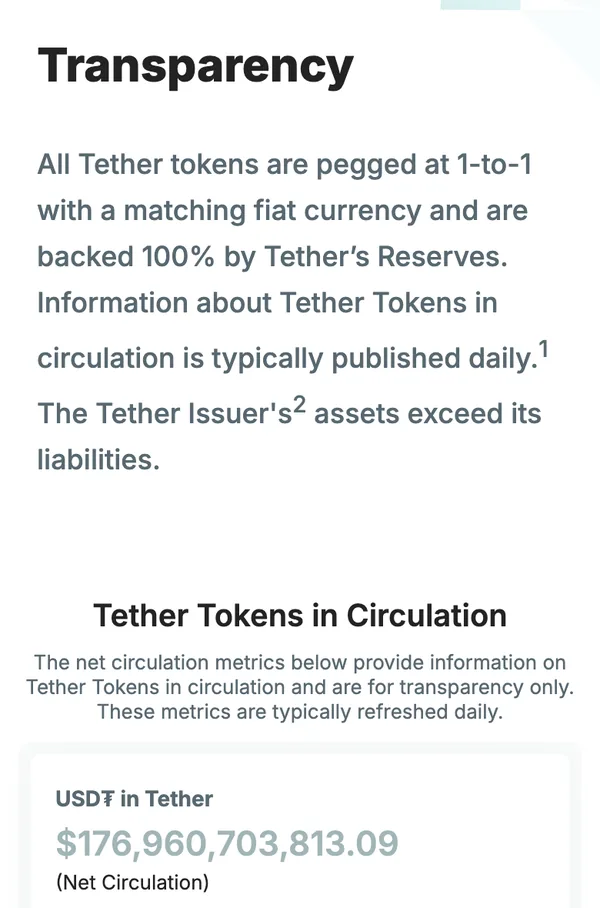
The same page breaks it down by blockchain: about $92.3 billion on Tron (TRC20) and $80.6 billion on Ethereum (ERC20), with smaller amounts on Solana, TON and others. Those two networks carry over 90% of all USDT, which is why they are the two options you see most when you withdraw from an exchange.
Why 1 USDT is worth $1
A stablecoin is only as good as its reserves: for every USDT issued, there should be at least a dollar of assets behind it. Tether publishes a reserves report every quarter. The latest one, as of 30 September 2026:
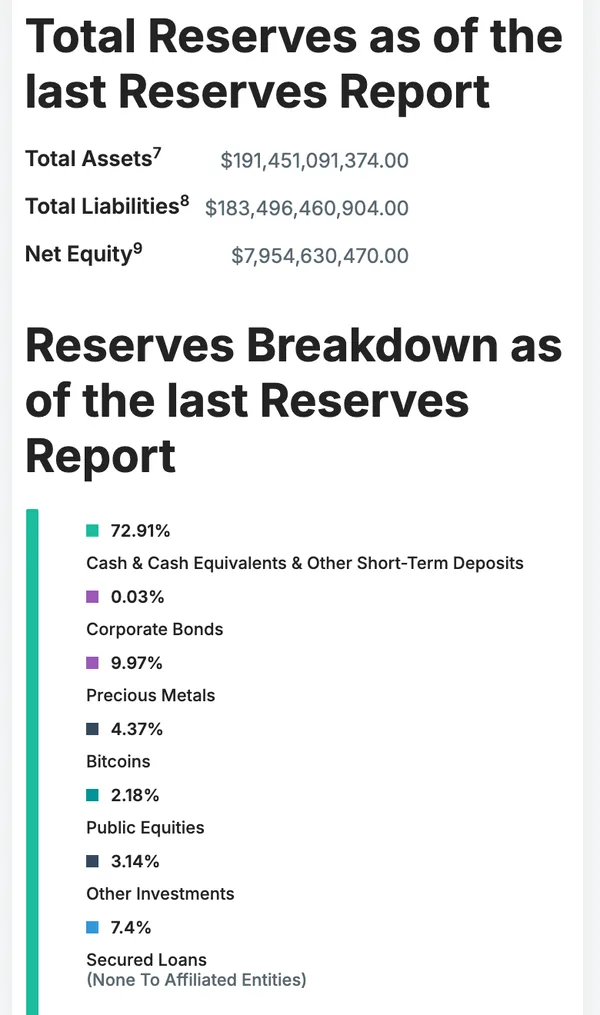
- Total assets about $191.45 billion against total liabilities of $183.50 billion, leaving a buffer of about $7.95 billion above what it owes USDT holders.
- 72.91% is cash, cash equivalents and short-term deposits, and 88% of that is US Treasury bills, among the most liquid assets in the world.
- The rest includes precious metals (9.97%), secured loans (7.4%) and Bitcoin (4.37%).
Each quarterly report comes with an independent assurance report by the accounting firm BDO, published on Tether’s site for anyone to download:
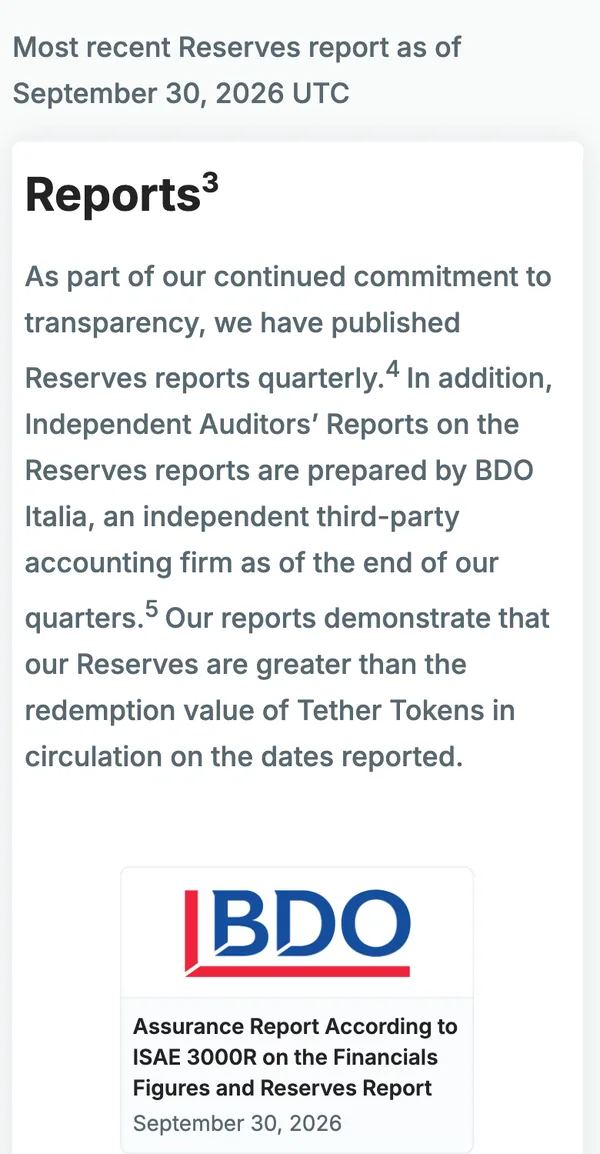
In short: USDT is backed by a large pool of mostly US government debt, reported publicly on a regular schedule and checked by a third party. That is what lets people around the world treat it as a real dollar.
Figures and screenshots checked: 2026-11-10. Circulation is from Tether’s daily transparency data; reserve figures are from the quarterly report as of 30 September 2026.
Why people choose USDT
- It holds its value. Of the 46 currencies we track, USDT trades within 3% of the reference dollar rate in 20. Where local money is losing value fast, people happily pay a little more to hold dollars: see the USDT premium by country.
- It is fast. Transfers settle on the blockchain in minutes, on weekends and holidays too.
- It is cheap to send. Instead of wire fees and intermediary bank charges, you pay one network fee. Check the exact amount on your exchange’s withdrawal page; Tron is usually far cheaper than Ethereum.
- It works almost everywhere. OKX, Binance, Bybit, Bitget and HTX all run P2P markets, and we track USDT prices in 46 currencies. Wherever you are, you can usually buy USDT with local money or turn it back into cash.
- It is useful. Freelancers get paid in it, families use it to send money home, traders need it to buy other coins, and savers keep part of their money in it as dollars.
Buying USDT with local money
On a P2P market the platform matches you with a seller and holds the USDT in escrow. You pick an ad, pay the seller in local currency, and the seller releases the USDT to your account once the payment arrives. Here is OKX P2P in Nigeria:
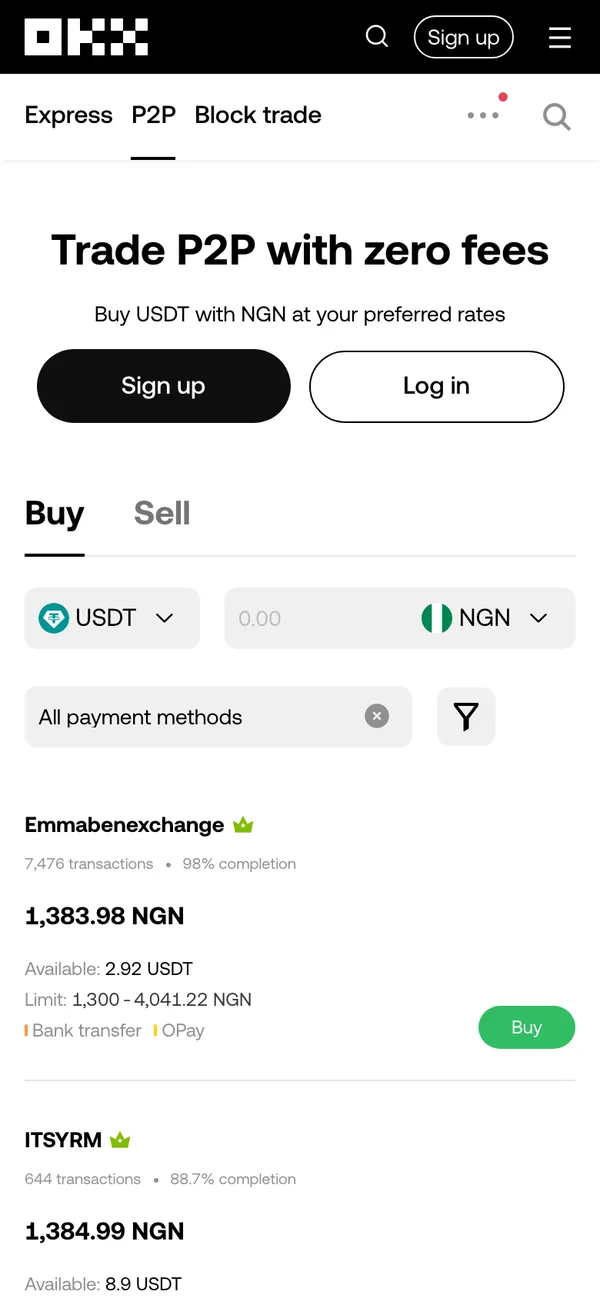
When we took the screenshot, sellers were asking 1,383.98 and 1,384.99 NGN for 1 USDT, close to the reference rate of 1,352.07 NGN per dollar. Right now the OKX median is 1,417.00 NGN. Prices are set by each seller, so compare first: our USDT to Naira rate today shows every platform side by side, and Find a seller lists the cheapest ads that fit your amount. Other countries: USDT P2P rates in all currencies.
Step-by-step guides: How to buy USDT on OKX P2P and How to buy USDT on Binance P2P.
Using USDT safely
- Match the network. If the receiving address is on Tron, send on TRC20; if it is on Ethereum, send on ERC20. Send a small test amount to any new address first.
- Pay and get paid only from accounts in your own name. P2P sellers check that the names match. Never pay on someone else’s behalf.
- Release only after the money is really in your account when you sell, and do not trust payment screenshots alone.
- Ignore “guaranteed returns”. USDT does not earn money on its own. Anyone promising high profits if you send them USDT is running a scam.
- Turn on two-factor authentication with a passkey or an authenticator app the day you open an account, and install apps only from official websites.
Common questions
Is USDT the same as Tether?
Yes. USDT is the token, Tether is the company that issues it, and people use both names. It is designed so that 1 USDT is worth 1 US dollar.
Is 1 USDT always worth exactly $1?
Tether redeems USDT at 1 to 1, and on large exchanges it trades within a tiny range around $1. On P2P markets you pay in local currency at a price set by each seller, so the rate can sit slightly above or below the reference exchange rate. Compare sellers before you buy.
What backs USDT, and who checks it?
Tether publishes a reserves report every quarter with an independent assurance report by the accounting firm BDO. As of 30 September 2026 it reported about $191.45 billion in assets against $183.50 billion in liabilities, a buffer of about $7.95 billion. 72.91% of reserves were cash, cash equivalents and short-term deposits, mostly US Treasury bills.
What is the difference between TRC20 and ERC20 USDT?
Both are real USDT on different blockchains: TRC20 on Tron, ERC20 on Ethereum. They are worth the same, but the sender and the receiver must use the same network, or the transfer can be lost. Tron is usually the cheaper network for everyday transfers.
Where should I keep my USDT?
For small amounts, your own exchange account with two-factor authentication is fine. For larger or long-term holdings, a wallet where you control the recovery phrase is an option; write the phrase on paper and never share it.
Do I pay fees to buy USDT on P2P?
OKX and Binance do not charge a platform fee on P2P trades. Your cost is the seller’s price, which differs between sellers and platforms, so compare before you order.
Is USDT risk-free?
No asset is. The issuer, the rules where you live and the platform you use all matter. Tether publishes its circulation daily and its reserves quarterly so you can check for yourself, and spreading funds between a trusted platform and your own wallet is safer than keeping everything in one place.